
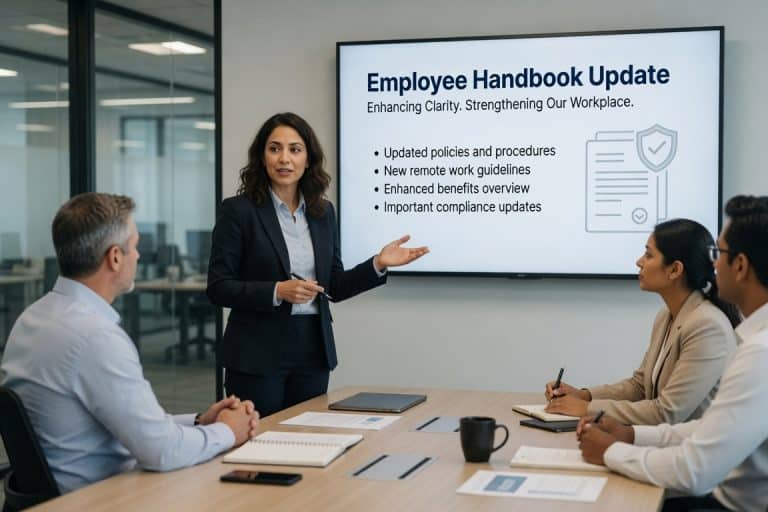
Compliance is no longer a secondary consideration for small business owners and HR administrators. A timely employee handbook update has become one of the most practical ways to reduce confusion, document expectations, and protect the business when employment laws, benefits rules, payroll practices, and workplace technology continue to change.
The cost of being reactive is measurable. In fiscal year 2025, the U.S. Department of Labor’s Wage and Hour Division recovered more than $259 million in back wages for nearly 176,957 employees. In fiscal year 2024, the EEOC secured almost $700 million in monetary relief for about 21,000 victims of employment discrimination.
For Texas and DFW employers, the handbook is not just an onboarding document. It is a risk-control tool that connects human resources, payroll, benefits, leave administration, employee conduct, technology use, and workplace expectations. When it is outdated, managers may rely on old language, employees may misunderstand their rights, and leadership may assume a process is covered when it is not.
Why an Employee Handbook Update Matters This Year
An employee handbook update matters because compliance exposure is increasingly connected to everyday business operations. Wage and hour decisions, leave requests, accommodation conversations, benefit notices, remote work rules, harassment reporting, and data access all touch the handbook in some way.
Employers often discover risk after something has already gone wrong. A manager handles a leave request inconsistently. A payroll classification does not match actual duties. A benefits notice is missed. An employee uses AI tools with confidential information. A remote employee works from another state without HR realizing the policy implications.
A well-built handbook helps prevent those issues by setting clear expectations before there is a dispute. It gives managers a consistent framework and gives employees a reliable source of truth.
This is especially important for growing businesses. NAPEO reports that PEOs provide services to 173,000 small and mid-sized businesses employing 4 million people, and businesses using PEOs have historically shown faster growth, lower turnover, and stronger business survival outcomes than comparable businesses not using PEOs.
Compliance Risks Employers Should Review First
The first step in a handbook review is identifying where the company has the highest risk. For many small and mid-sized employers, the biggest gaps are not caused by intentional noncompliance. They come from outdated language, inconsistent enforcement, or unclear ownership between HR, payroll, benefits, managers, and third-party vendors.
Start with policies that affect protected rights, wages, benefits, and employee complaints. These areas tend to create the most immediate exposure when they are mishandled.
Key policies to review include:
- Equal employment opportunity and anti harassment
- Complaint reporting and investigation procedures
- Reasonable accommodation
- Pregnancy and lactation accommodation
- Wage and hour practices
- Timekeeping and overtime approval
- Employee classifications
- Leave of absence policies
- Benefits eligibility and COBRA notices
- Remote work and offsite work expectations
- Data privacy and acceptable technology use
- AI use in hiring, HR, and employee workflows
The Pregnant Workers Fairness Act is a strong example of why handbook language should be current. The PWFA went into effect in 2023, and the EEOC’s final regulation took effect on June 18, 2024. It requires covered employers to provide reasonable accommodations for known limitations related to pregnancy, childbirth, or related medical conditions unless doing so would create undue hardship.
Human Resources Policies That Need a Closer Look
Human resources policies should be written for real workplace situations, not just legal coverage. A policy that sounds compliant but cannot be followed by managers is still a risk.
For small business owners and HR admins, the most important question is whether the handbook reflects how the company actually operates today. If your business has added locations, grown headcount, introduced remote work, changed benefits, hired in new states, or adopted new software, the handbook should reflect those changes.
Policies that deserve special attention include employee conduct, attendance, discipline, progressive coaching, workplace investigations, confidentiality, social media, workplace violence prevention, and manager escalation procedures.
Your handbook should also explain how employees raise concerns. Employees should know where to go, what information to provide, and that retaliation is prohibited. Managers should know when to stop improvising and escalate the issue to HR.
ESI’s role is to help employers move from informal practices to documented processes. That matters because compliance is easier to defend when policies, manager actions, payroll records, and employee communications align.
Payroll Benefits and Leave Language Can Create Exposure
Payroll, benefits, and leave policies are often where outdated handbook language creates the most costly problems.
For payroll, employers should review exempt and nonexempt classifications, overtime rules, meal and rest break practices where applicable, timekeeping procedures, pay corrections, final pay, bonuses, deductions, expense reimbursement, and remote work time tracking.
Federal overtime rules have also seen important movement. On May 14, 2026, the U.S. Department of Labor announced a technical amendment removing the vacated 2024 overtime rule language and restoring the operative 2019 regulations. The restored federal salary level for most executive, administrative, and professional exemptions is $684 per week.
For benefits, employers should review eligibility language, enrollment windows, qualifying life events, plan documents, summary plan descriptions, COBRA administration, ACA responsibilities, and employee communication practices. COBRA generally applies to private-sector group health plans maintained by employers with at least 20 employees on more than 50 percent of typical business days in the prior calendar year, and it requires continuation coverage notices when qualifying events occur.
For leave, employers should review FMLA, military leave, jury duty, disability accommodation, pregnancy accommodation, paid time off, sick leave, bereavement, voting leave, and any state or local leave requirements that apply to their workforce. Texas private employers with fewer than 15 employees generally are not required by state or federal law to provide family leave, paid or unpaid, but larger employers and multi-state employers may have additional obligations.
AI Remote Work and Data Privacy Belong in the Modern Handbook
A modern employee handbook update should address technology and data use directly. Many employers now use HRIS platforms, payroll portals, timekeeping systems, benefits tools, applicant tracking systems, chat platforms, and AI-supported workflows. Employees may also use publicly available AI tools to draft content, summarize documents, or process information.
That creates new questions. Can employees enter confidential company information into AI tools? Can managers use AI to help screen applicants? Who approves HR technology vendors? What happens when remote employees access employee data from personal devices? How are access rights removed when someone leaves?
Texas employers should also pay attention to AI regulation. Texas House Bill 149, known as the Texas Responsible Artificial Intelligence Governance Act, was signed on June 22, 2025, and takes effect January 1, 2026. The law creates a state AI regulatory framework and includes prohibitions related to discriminatory AI practices.
Your handbook does not need to explain every technical detail, but it should establish clear rules around acceptable use, confidentiality, employee data, approval of tools, and escalation when employees are unsure.
Where PEO Support Can Simplify the Process
A handbook update is not just a writing project. It is a coordination project.
The handbook should line up with payroll practices, benefits administration, risk management, HR workflows, onboarding, manager training, and employee communications. When those pieces are handled separately, small gaps can become expensive.
This is where PEO support can simplify the process. ESI helps employers connect policy language to actual operations by reviewing how the business handles HR, payroll, employee benefits, workers compensation, compliance support, risk management, and technology.
For employers in Texas and DFW, this support can be especially valuable when the business is growing, adding employees, managing multiple job types, or trying to professionalize HR without building a large internal department. NAPEO’s 2025 research found that half of PEO clients have between 10 and 49 employees, and slightly more than half of PEO clients are located in Florida, California, New York, and Texas combined.
The goal is not just to have a handbook. The goal is to have policies that managers can follow, employees can understand, and leadership can defend.
Employee Handbook Update Checklist
Use this checklist as a starting point for your next review.
- Confirm company information, locations, and employment categories are current
- Review EEO, harassment, retaliation, and complaint reporting policies
- Update reasonable accommodation and pregnancy accommodation language
- Review exempt and nonexempt classifications
- Confirm timekeeping, overtime, and payroll correction procedures
- Align PTO, sick leave, FMLA, jury duty, military leave, and other leave policies
- Review benefits eligibility, COBRA references, and employee benefit communication
- Add or update remote work and hybrid work expectations
- Add AI use, data privacy, cybersecurity, and confidentiality language
- Review social media, workplace conduct, and electronic communications policies
- Confirm safety, workers compensation, and injury reporting procedures
- Update employee acknowledgement language
- Train managers on the policies they are expected to enforce
- Keep a documented review date and version history
FAQs for Employee Handbook Update
What is an employee handbook update?
An employee handbook update is a review and revision of company policies to reflect current laws, workplace practices, benefits, payroll procedures, technology use, and employee expectations.
How often should employers update an employee handbook?
Employers should review the handbook at least annually and whenever major legal, operational, payroll, benefits, or workforce changes occur.
Why does an employee handbook update matter for small businesses?
Small businesses often rely on managers to make quick decisions. A current handbook gives managers guidance, helps employees understand expectations, and creates documentation if a dispute arises.
What policies should be reviewed first?
Start with anti harassment, equal employment opportunity, complaint reporting, reasonable accommodation, pregnancy accommodation, wage and hour, leave, benefits, remote work, confidentiality, and technology use.
Should Texas employers update their handbook in 2026?
Yes. Texas employers should review federal requirements, Texas-specific workplace rules, AI-related developments, remote work practices, payroll procedures, and any city or industry-specific obligations that may apply.
Does a handbook need an AI policy?
Most employers should now include AI guidance. The policy should address acceptable use, confidential information, employee data, tool approval, hiring workflows, and manager accountability.
What payroll policies should be included in a handbook?
A handbook should explain timekeeping, overtime approval, pay periods, payroll corrections, deductions, final pay procedures, expense reimbursement, and employee classification basics.
What benefits policies should employers review?
Employers should review benefits eligibility, enrollment, qualifying life events, COBRA references, employee contributions, plan document references, and who employees should contact with benefits questions.
Can a PEO help with employee handbook updates?
Yes. A PEO can help align handbook language with HR administration, payroll, benefits, compliance support, risk management, and employee communication practices.
How can ESI help with policy and handbook compliance?
ESI helps employers identify HR, payroll, benefits, compliance, and risk-management gaps, then supports clearer processes, stronger documentation, and more consistent workforce administration.
How ESI Manages Employee Handbook Update
An employee handbook update is one of the clearest ways for employers to move from reactive HR to defensible HR. It helps small business owners and HR admins reduce confusion, align policy with actual practice, and create documentation before a complaint, audit, wage claim, leave dispute, or benefits issue occurs.
The best time to update the handbook is before the business is under pressure. ESI supports employers with HR, payroll, benefits, compliance, risk management, and technology solutions designed to simplify employment challenges and give leadership a clearer path forward. ESI’s website describes its mission as simplifying the employment challenges of business, with expertise across human resources, workers compensation and risk management, employee benefits, retirement packages, payroll administration, and more.
Read More: Employee Handbook Update
Know More- HR@eESIpeo.com


