
National PEO Week (the third full week of May) is more than an industry celebration—it’s a spotlight on the behind-the-scenes support that helps small and mid-sized businesses run cleaner, safer, and stronger.
When businesses are supported, people and communities move forward.
And that support shows up in real, practical ways—stronger benefits, smarter HR support, better compliance and risk management, and more efficient operations—giving owners time back to focus on growth and giving teams the structure to perform.
The Week in Review: 3 Big Takeaways
The “PEO Tipping Point” is real—and it sneaks up fast
One of the clearest patterns we highlighted this week: there’s a moment when growth creates complexity faster than internal bandwidth can handle.
It’s not just “more employees.” It’s more everything—multi-state rules, benefits renewals, hiring pressure, workers’ comp exposure, documentation, and the constant HR decisions that land after hours.
Signs you’re at (or nearing) the tipping point:
- HR/compliance living in the owner’s (or CFO’s) inbox after hours
- Benefits costs rising, but hiring still feels uphill
- Employee issues handled reactively instead of through a repeatable process
- Workers’ comp uncertainty or claims anxiety
- Multi-state operations (or expansion plans) creating new compliance risk
If you saw yourself in 2+ of those, the week’s message was clear: a PEO conversation can create immediate lift—not “someday,” but now.
PEOs are growth partners—because they remove friction from the business
In our “growth partners” post, we framed PEOs the way business owners actually experience them: as the operational backbone that helps leadership teams stop playing defense.
PEOs support employers with the day-to-day load—payroll and tax administration, benefits access, HR expertise, workers’ comp/risk management, compliance support, and technology that modernizes HR operations.
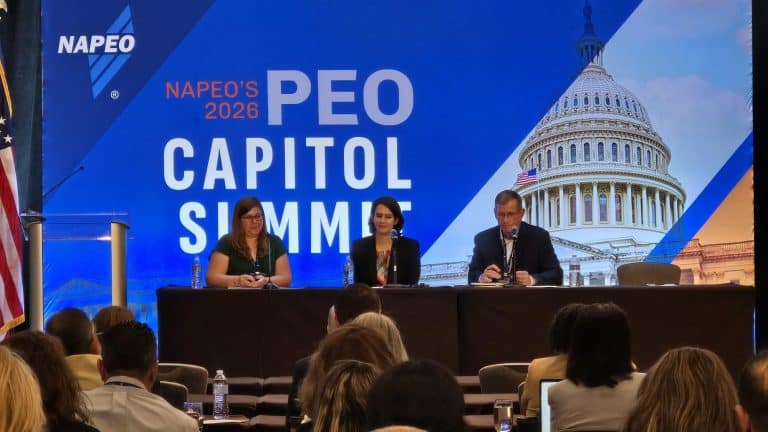
And the footprint is significant: PEOs support hundreds of thousands of businesses and millions of employees nationwide, which is why National PEO Week is both recognition and advocacy (including NAPEO’s Capitol Summit efforts during the week).
The HR backbone deserves the spotlight—because “stronger” is measurable
The “HR backbone” post reminded everyone that PEO support isn’t hype—it’s measurable impact.
NAPEO’s industry fact sheet notes that PEOs serve 173,000 small and mid-sized businesses employing 4 million people, with 487 PEOs operating across the U.S., and those clients representing 15% of employers with 10–99 employees.
And outcomes matter:
- Businesses using a PEO grow 7–9% faster
- Experience 10–14% lower turnover
- Are 50% less likely to go out of business
That’s why this week resonated: it validated what many employers already feel—when HR, benefits, compliance, and risk are supported the right way, growth becomes more predictable.
NAPEO Week Highlights: What “PEO Support” Looks Like in Real Time
Across social and blog content, the recurring highlights were consistent:
- Better benefits that help you compete for talent
- Stronger HR support that builds consistency (and reduces emotion-driven decisions)
- Smarter compliance and risk management that protects what you’ve built
- More efficient operations that give leadership time back to focus on growth
Make National PEO Week Useful: 3 Actions You Can Take Right Now
If you want a practical takeaway from the week, here’s the “do this next” recap we emphasized:
- Compliance pulse-check (handbook, I-9s, classifications, documentation flow)
- Benefits reality check (are you winning candidates—or just paying more each renewal?)
- Risk review (claims trends, safety habits, training gaps, biggest exposure)
You don’t need a massive project—just clarity on what’s costing you time, money, and momentum.
Closing Thought
National PEO Week is a reminder that small businesses shouldn’t have to choose between growth and control.
The right PEO partnership helps businesses build a stronger foundation—so owners can scale, retain talent, stay compliant, and reduce risk without carrying the entire burden internally.


